• NEWS - PRESS - Uncategorized

    Review of “Karma” OST on BuySoundtrack

    http://buysoundtrax.com/larsons_soundtrax-7-25-18.html

    KARMA/Kristian Sensini/Records DK – digital
    KARMA is an independent Italian supernatural horror film made in 2017. It received a limited release in Italy, but it was shortened to a 24-minute version which has been posted to Facebook. It’s a pretty provocative movie, and very nicely scored by Kristian Sensini (HYDE’S SECRET NIGHTMARE, ROCKS IN MY POCKETS), whose music has been released as a digital soundtrack. The plot has to do with six teenage boys who, over the course of a weekend, will soon have to face off against their karma, as an evil entity seeks to punish them for their mistakes. “The music I wrote for the movie has a sort of ‘woodish’ quality,” Sensini told Soundtrax. “I’ve extensively used strings (particularly the low textures of cellos and basses) and woodwinds because they remind me of the warm and dark nature of the wood that has a special part in this movie. I’ve tried to avoid the classical horror soundtrack clichés and give each cue in the movie its unique “breath,” in the true sense of the word: if you listen carefully, you can actually feel a mysterious and ominous breath (done with instruments). It’s as if the soundtrack itself is the Evil, a character that is watching the young boys and waiting in the Darkness, ready to hit.”
    The digital soundtrack is available from amazon, iTunes, and can be heard on Spotify.
    For more information on the composer, see www.kristiansensini.com.


    Buy Soundtrax KARMA

  • PRESS - Uncategorized

    Karma – Review by Film Score Monthly

    logo4

    Full album available at https://itunes.apple.com/us/album/karma-atonement/id1211759271

    Karma follows a group of young boys whose past behavior catches up with them as they are tested and punished by an embodiment of evil. The film’s horrific score comes
    courtesy of Kristian Sensini (Rocks in My Pocket, La Sorpresa). Karma’s opening title track features an enticing arpeggiated idea and a long, lyrical line with a gothic feel. “Staircase” pushes forward with an intriguing melody that again references the arpeggiating figure before becoming more disjointed as it slowly moves upward over a menacing undertow. By contrast, the “Woods Theme” features a soaring
    high string idea over rich low strings and a breathy vocalise.
    The score overall does a fine job of establishing subtle textures that become creepier as various motivic components float through them, evidenced in tracks like “Tensive
    Dialogue” and “Dirty Secrets.” Similarly, many cues feature low pedals and slow builds that add tension, which occasionally releases, as in “The Attic.” The arpeggiated idea
    also recurs throughout the album as connective tissue.
    “The Cellar” moves us most firmly into horror territory, with close intervals and sudden hits set against a high string drone. After a passage for a music-box melody and crescendoing vocals, the cue moves into a quasi- rock-based section reminiscent of a Richard Band score.
    “Abductions” offers more macabre sounds intermingled with low strings, including a cello line that lends an emotional pull to the proceedings. The “Trailer” music wraps up the playlist nicely, providing one last burst of intense horror music.

    Karma FSM ONLINE

  • NEWS - Uncategorized

    My Love Affaire With Marriage

    “My Love Affair With Marriage” is the title of the new animated feature film that I’m working on, directed by Signe Baumane.

    Our past work (“Rocks in My Pockets”) brought us close to an Oscar nomination (Academy Awards)… we will try again with this exciting new film.
    Part of the cast is Matthew Modine an actor that we all know from his participation in the television series “Stranger Things”, but above all for his starring role in Kubrick’s “Full Metal Jacket”.

    Here’s the news from Variety
    https://www.kickstarter.com/projects/1055277857/my-love-affair-with-marriage

    I write because this project needs the help of you and your friends.
    The director started a fundraiser on Kickstarter – this independent animated feature cannot rely on the budgets that Disney, Pixar and Dreamworks have.

    This project is being made by having independent film fans fund the film, “pre-buying” the movie, which will ensure its production.
    Just to explain how the animation business works for feature films, to put a professional actor under contract to dub any character, no matter the budget of the film (independent or a blockbuster), the costs are the same. Consequently an independent producer must pay the same actor rates as the giants such as Disney.
    For this I ask you please to click on this link:

    www.KickstartMarriageFilm.com

    Please make a small donation, pre-purchasing the film perhaps, or a larger one for some great rewards.
    Otherwise spread the word by sharing the link on Facebook, Twitter or email – just getting the word out is critical.

    Thanks in advance for helping this little (big!) Project. Independent art needs the support of those who benefit from it – us.
    In these complicated times, supporting art and culture (in all its forms) is the most revolutionary act that we can do.
    Below is a synopsis of the film in the words of the Director:
    “My Love Affair With Marriage” is based on my personal experiences – I have been married two times and could never understand why those marriages didn’t last longer than they did. To unravel this mystery, I set out to research the neuroscience and mythology of love.
    I decided to weave my many discoveries into the single story of Zelma, a fiery young woman with a wild imagination, who believes that love will make her a complete human being with four arms, four legs and two heads. Zelma keeps falling in love, but something always goes wrong. She journeys through many marriages, some real, some imaginary, while confronting pressures from society and her own biology. Although the marriages fail to make her complete, they, like baptism by fire, transform her.
    This story is driven by 26 speaking and four singing characters. The singers are the chimerical, shapeshifting Mythology Sirens, who, with their seductive songs, lure Zelma into fantasies of everlasting love and never-ending happiness.

    One of the best film composers I know is Kristian Sensini of Italy, who scored “Rocks In My Pockets”. Kristian has agreed to join us and write the songs for “My Love Affair With Marriage”, as well as score the film. It is a great honor to work with Kristian again! He is an excellent collaborator who always goes the extra mile!”
    Kristian

  • NEWS - PRESS

    Recensione “La Sorpresa”– Colonnesonore.net

    Condivido con un certo orgoglio la bella recensione di ColonneSonore.net (Massimo Privitera) della mia partitura per il film La Sorpresa di Ivan Polidoro

    http://www.colonnesonore.net/recensioni/cinema/4546-la-sorpresa.html

    Il cd è disponibile (a tiratura limitata) al seguente indirizzo http://www.cdbaby.com/cd/kristiansensini3
    La versione digitale invece la trovate in tutti gli stores…digitali.


    Scritto da Massimo Privitera. Pubblicato in Cinema

    Kristian Sensini
    La sorpresa (2015)
    Keyestudios
    15 brani – Durata: 38’10”

    Kristian Sensini, vincitore del nostro Premio dei lettori nel 2014, nella categoria Migliore Musica per Film Straniero, per la pellicola d’animazione lituana Rocks In My Pockets, si approccia musicalmente a questo dramma familiare di Ivan Polidoro con una grazia sospesa colma di trepidazione emotiva. Fin dalla prima traccia, “Attese”, si tratteggia l’andatura sonora della score, con violino, viola e violoncello (tutti suonati accoratamente da Cristiano Giuseppetti) che lenti, quasi timidi, cantano amaramente il tema portante, ed il flauto (suonato da Sensini), col suo sopraggiungere mesto e desolato, ne marca ulteriormente il carattere drammatico.

    Elettronica ancestrale e un piano astratto si addentrano nei segreti nascosti del film, in “La sorpresa 1”, nel mentre “Come sospesa” tra sintetismi, flauto e chitarra (Jan Mozzorecchia) cerca di rasserenare questa complicata storia di un rapporto a tre (padre, figlia e infermiere che cura il primo gravemente ammalato) con un secondo tema fondamentalmente malinconico ma che ricerca qualche spiraglio di vitalità. Cameristico per archi viene eseguito il tema principale in “Devotio”, divenendo ancor di più elemento straniante e amareggiato. Un piano gocciolante e cantilenante (“Figlia del padre”) su effetti ritmici a pioggia raffigura la figura della figlia ventenne che non trova alcun punto di contatto con il padre che ormai stanco, desidera solo morire. Liturgico e angelico il canto per voce sdoppiata eterea di Laura Bruno in “Ana Yelena”. “Padre” assegna il compito ad una viola con effetto eco accentuato di cantare dolorosamente il leitmotiv di questo padre che solo nelle cure dell’infermiere trova le amorevoli attenzioni di un figlio non figlio che la sua vera figlia non riesce a offrirgli. Una nenia sintetica, quindi lontana nel suo suono metallico freddo, interpreta il tema principale in “La sorpresa 2”. Una “Ragnatela” metaforica più che reale nel canto straziato degli archi, della chitarra e di ritmiche asettiche prova a scavare nelle microtrame di questa vicenda piena di dolori e segreti. “Ana Yelena 2” rincontra il canto religioso di Laura Bruno con sfumature liturgico-orrorifiche tra Schubert e Keith Emerson. “Surprise me” gioca su ritmiche ipnotiche e synth anni ’80 carpenteriani. “La sorpresa” ondeggia glassianamente tra il suono insistito degli archi, liquescenze ritmiche e un piano ribattuto. “Un tango”, lo dice il titolo stesso, è un ballabile appassionato dalle ritmiche moderne intriso di reminiscenze piazzolliane: molto bello e virtuoso! In “Ana Yelena 3” il canto raddoppiato della Bruno assume valenze più incorporee insieme al controcanto del piano. Chiude il CD “La sorpresa piano” nel quale il leitmotiv primario mostra tutta la sua grazia addolorata in cerca di redenzione. Una partitura che entra sottopelle dopo svariati ascolti e che fa rivivere in noi ciò che di più nascosto risiede nel nostro animo.

    La sorpresa - colonnesonore

  • NEWS

    Jerry Goldsmith Awards 2016–Nominees Best Documentary

    I’m happy to share this news! The Music I wrote for the Documentary “Vive Solo Chi si Muove” received a nomination at the Jerry Goldsmith Awards .
    With this one I celebrate my tenth nomination at the Awards, six years in a row!

    You Can listen to the Soundtrack and watch the documentary at the following link

    https://www.kristiansensini.com/vive/

    premios-jerry-goldsmith-diplomas

    http://www.bsospirit.com/2016/06/15/finalistas-de-los-premios-jerry-goldsmith/

    In a year where BSOSpirit Association begins its collaboration with the Festival of Malaga, and specifically with its new and exciting project, the Movie Score Malaga – MOSMA, we posed several challenges to achieve. First, give the awards a projection we’ve always wanted for them. And Malaga is the perfect place, thanks to the organizational skills and experience of such a prestigious team like the one that is behind this important Spanish Film Festival.

    Another challenge was to review the bases of the awards. There were composers who, although no longer young in age, they were young in spirit, and they felt were prevented to participate in these awards because the awards limited participation to young age composers.

    In recent years we were raising our hand regarding thisissue, and we think that from this second stage of our “Jerrys” once we passed our first decade of existence, we should revise our regulations and open these awards to all those who feel young of spirit when composing for the audiovisual media and not only of young age.

    Those who would like to see enhanced, and sometimes to let their wonderful work be discovered. Or those who feel that these awards are a clear representation of that reason why, one day, they decided to become music composers for the audiovisual media. Perhaps because of the great name that sponsors this awards, the late great Jerry Goldsmith, a composer with an undying young spirit.

    This new and exciting era for the awards, start now. And it does so, with an exemplary in regards of the level of its participants. More than 110 composers from three continents, and more than 260 jobs in 11 categories that this year conformed this XI edition of the Jerry Goldsmith Awards.

    Los finalistas de cada categoría son / Finalists in each category are:

    PARALLEL UNIVERSES

    Jonay Armas / Zombies

    Nikolas Labrinakos / Parallel Universe

    Manel Miralles / Hell in 16mm

    LIBRE CREACIÓN / FREE CREATION

    Sonya Belousova / The House of Bernarda Alba

    Carla F. Benedicto / Hope

    Maximilien Mathevon / Wild

    Romain Paillot / Beyond

    Brian Satterwhite / Metropolis

    CANCIÓN / SONG

    Luigi Ferri y Giulia Penna / Perdeti Ora

    Jean-Philippe Ichard / My Little Bird

    Alexandre Lecluyse / Coup de Fudre

    Luc Suárez / Be Aware

    Josue Vergara / Sonrie

    PROMOCIÓN / PROMOTIONAL WORKS

    Nico Casal / Ford: Sin Limites

    Daniel Díaz / Xove Emociona

    Luis Hernaiz / Marcial

    Julie Reier / Stand with Sanju

    Iván Ruiz / Nancy, la Madre de Thomas Edison

    PUBLICIDAD / ADVERTISING

    Javier Bayón / Are You In?

    Nico Casal / Estrella de Galicia

    Daniel Díaz / Sogama

    Stuart Hancock / KFC: Sisters

    Joan Vilá / Moritz

    TELEVISION Y WEB SERIES / TELEVISION AND WEB SERIES

    Jamie Christopherson / Loves Finds You in Valentine

    Giona Ostinelli / The Massively Mixed-Up Middle School Mystery

    Stuart Hancock / Atlantis: Season 2

    Jorge Puig / Misión Ciencia

    Marc Timón / In Absentia

    DOCUMENTAL / DOCUMENTARY

    Stephen Baysted / Renoir: Revered and Reviled

    Miguel d’Oliveira / The Trans Siberian Adventure

    Giona Ostinelli / The Human Capital

    Kristian Sensini / Vive Solo Chi Si Muove (Moving to Live)

    Alan Williams / Moving Art: Underwater

    VIDEOJUEGO / VIDEO GAME

    Neal Acree / Revelation Online

    Daniel Díaz / Subterrain

    Fran Romguer / Kick or Die

    Isabel Royan / Paula: The Game

    CORTO DE ANIMACIÓN / ANIMATED SHORT FILM

    Mathieu Alvado / Construire un Feu

    Aaron Kenny / Disconnect

    Filipe Leitao / Grounded

    Jamie Messenger / The Orchestra

    Adriaan Swerts / Isle of Skye

    CORTO DE ACCIÓN REAL / LIVE ACTION SHORT FILM

    Matthieu Alvado / Quenottes

    Stuart Hancock / Killing Thyme

    Luis Hernaiz / La Jaula

    Aaron Kenny / A Mighty Nice Man

    Josué Vergara / Three Wise Monkeys

    LARGOMETRAJE / FEATURE FILM

    Joseba Beristain / The Plot Point

    Andrea Boccadoro / The Porter Brothers

    Alexander Cimini / Dark Water (Bellerofonte)

    Frank Ilfman / Abulele

    Alexandre Lessertisseur / Sheep & Wolves

  • NEWS - PRESS

    “La Sorpresa” Review on BuySoundtrax

    Soundtrax: Episode 2016-3
    April 11th, 2016

    By Randall D. Larson

    http://www.buysoundtrax.com/larsons_soundtrax-4-11-16.html

    LA SORPRESA/Kristian Sensini/KeyeStudios – ltd ed cd + digital
    Italian composer Kristian Sensini has released his latest score on his own, digitally. Be thankful. Directed by Ivan Polidoro, LA SORPRESA (The Surprise) is a family drama that focuses on the awkward relationship between a father and his estranged daughter, compounded when he suddenly grows ill and she must take care of him; in the process she grows more distant when a male nurse is brought in who provides the kind of loving care she cannot. Sensini (HYDE’S SECRET NIGHTMARE – see my review in my Nov. 2012 column; ROCKS IN MY POCKETS – see my review from the Oct. 2014 column) has provided an intimate score performed by a small string ensemble (violin, viola, cello), supplemented by guitar, flute, keyboard, and voice. The score begins with “Attese” (Expectations), a deeply morose intonation of cello chords that resonates with the sad disaffection between the woman and her father. Sensini’s title theme, with its highly reverberated keyboard underpinning, carries a poignant weight that is less harsh; its melody will drift throughout later cues to paint the family in colors of sympathy and sorrow (In “La Sorpresa 1,” the melody is taken by a synth-violin, while in “La Sorpresa 2,” Sensini gives the melody line to a toy piano, which, in referring to happier and younger days of the family, is quite touching). The awkwardness between father and daughter is adroitly summed up in the colorless measures of “Figlia del Padre,” while the close-miked cello melody evoked in “Padre” paints the father in a much more empathetic light. The voice of Laura Bruno is heard in several cues, including a recurring, hymnlike a capella motif titled “Ana Yelena” whose lyric repeats the titular name in beautiful, double-tracked harmony. The film’s turning point and score’s apotheosis is found in “Ragnatela,” an uplifting harmonic treatment for all three strings over an interplay of muted drums and electric guitar which offers a serene resolution to the distance inflicted upon father and daughter. A drum kit is added for “Un Tango,” adding a nice contemporary pop rhythm to the tango’s string melody and harmony; the drums are also present for the second reprise of “La Sorpresa,” where the melody is presented in a more positive tempo and much brighter harmony, the family’s journey from alienation is finding its reunion and redemption. “Surprise Me” is a pretty pop-styled melody played on keyboards with digital handclaps and drum-kit. LA SORPRESA is a thoroughly engaging and beautiful score, deeply honest and moving in its sensitivity and treatment of its subject matter.
    The digital album is available on Italian iTunes and Amazon and elsewhere in the US.  A signed CD edition is available in limited quantities (100/c) from CDBaby.

    Randall Larson - La Sorpresa

  • NEWS - PRESS

    Intervista su Moveorama

    http://www.moveoramag.com/intervista-kristian-sensini/

    Tra i compositori più attivi nell’eterogeneo panorama cinematografico indipendente italiano c’è sicuramenteKristian Sensini. Dal 2009 ad oggi ha ufficialmente all’attivo 20 collaborazioni (le più recenti, “Fighting for Death” e “L’esodo”, quest’ultimo ancora in fase di lavorazione), tra cortometraggi e lungometraggi ma anche una serie tv nazionale come “Provaci ancora prof!” (6 episodi).

    Una collaborazione particolarmente solida è poi quella con il regista Domiziano Cristopharo, fin dall’esordio di quest’ultimo dietro la macchina presa con “House of Flesh Mannequins – La casa dei manichini di carne” e proprio per il regista romano ha prestato servizio nella trilogia “P.O.E.

    Ispirandosi ai racconti di Edgar Allan Poe un pugno di autori sono stati coinvolti da Cristopharo (a sua volta autore) a realizzare dei cortometraggi che, messi insieme, hanno dato vita ad una vera e propria raccolta cinematografica. Un’operazione importante dal punto di vista produttivo (ha di fatto aperto la strada alla realizzazione, nel cinema indipendente italiano, di altri film a episodi) che partita nel 2011 con “P.O.E. Poetry of Eerie” ha partorito anche “P.O.E. : Project of Evil” (2012) e “P.O.E. Pieces of Eldritch (P.O.E. 3)” (2014). Titoli che, come detto, hanno visto la costante presenza proprio di Kristian Sensini.

    Noi gli abbiamo posto alcune domande sull’argomento ma non solo. Ecco cosa ci ha risposto.

    Scorrendo la tua biografia si legge che già all’inizio degli anni ’90 collaboravi come tastierista in numerose band. Una passione quella nei confronti della musica (oltre che un mestiere) che ti accompagna da oltre vent’anni. Come è nata?

    Ho iniziato a suonare a 7 anni circa, le classiche lezioni di pianoforte che si fanno per “provare” . Ho resistito appena qualche mese, probabilmente stressato dal solfeggio che terrorizza molti studenti (se insegnato male…). Ho poi proseguito da autodidatta, grazie al pianoforte a mezza coda che mio papà (nell’entusiasmo delle lezioni iniziali) decise di comprarmi. Avere uno strumento così ingombrante in casa ha fatto si che ogni tanto tornassi a metterci le mani sopra, suonando più che altro ad orecchio. Crescendo ho iniziato a formare i primi “complessini” con gli amici e di li non ho più smesso.

    Nel 2013 hai vinto il Global Music Award per “Hyde’s Secret Nightmare” di Domiziano Cristopharo. Come è nata la collaborazione con lui?

    Ho contattato Domiziano su Facebook, sapevo che lavorava come regista a progetti interessanti e semplicemente mi sono proposto di collaborare ad uno dei prossimi. Abbiamo iniziato con un brano per “The Museum of Wonders” e da li abbiamo collaborato a diversi progetti insieme, “Hyde’s Secret Nightmare” è forse quello al quale tengo di più perché ho lavorato alla colonna sonora nella sua interezza (tranne che per un brano, composto dal grande Alexander Cimini, quella scena non riuscivo proprio a risolverla).

    Parliamo del tuo lavoro sulla serie di “P.O.E.”, l’antologia horror curata da Domiziano. Innanzitutto quali sono state le suggestioni a cui hai attinto per questo lavoro?

    Non ho lavorato direttamente sulle immagini, ma ho cercato di ricreare le atmosfere delle colonne sonore horror degli anni ’80 di maestri come Frizzi e Simonetti, con un occhio anche al lavoro realizzato da Morricone per le musiche di Carpenter. Ho dunque utilizzato un mix di strumenti acustici ed elettrici, con l’aggiunta di synth rigorosamente vintage.

    Ci racconti del tuo lavoro su “P.O.E.”?

    Domiziano mi ha lasciato moltissima libertà per questo lavoro, mi sono occupato delle musiche dei trailer delle tre antologie, dei titoli di testa e di coda e di alcuni episodi girati dallo stesso Domiziano, per gli altri ogni regista ha portato nel progetto un diverso compositore. Sono stato sempre appassionato di letteratura Horror, in particolare di Poe e Lovecraft, lavorare ad un progetto del genere è stata una grande opportunità di “restituire” musicalmente quello che ho immaginato per tanti anni leggendo i racconti del maestro di Baltimora. Ho cercato però di aggiornare le sonorità ai giorni nostri per rendere la musica più in linea con l’intero progetto.

    Che tipo di rapporto si è stabilito fra regista e compositore?

    Quando lavoro con Domiziano o ci capiamo subito…o affatto, quando le nostre visioni si allineano lavoriamo benissimo e molto rapidamente. Domiziano ha una cultura musicale sconfinata (sicuramente maggiore della mia) ed è sempre un piacere seguire le sue indicazioni. Come detto in questo caso ho avuto carta bianca e la massima fiducia nel mio lavoro. Evidentemente è funzionato tutto alla perfezione.

    Come è cambiato, se è cambiato, il tuo approccio dal punto di vista lavorativo/creativo per i singoli capitoli?

    Non ho lavorato all’antologia nella sua interezza, è l’opera di diversi registi ed ognuno di essi ha coinvolto i compositori con i quali collaborano normalmente. Nelle 3 diverse antologie ho scritto titoli di testa o di coda, alcuni capitoli dell’antologia (in particolare quelli diretti di Domiziano) e alcuni dei trailers.

    locandine-poe

    Da compositore di successo pluripremiato, quai sono i tuoi consigli a chi vuole intraprendere questa carriera?

    Cercare di avere una solida cultura cinematografica innanzitutto, ci sono tanti musicisti bravissimi ma che spesso non sanno guardare al film ed alla musica con l’occhio del filmmaker. Poi è fondamentale smettere di ascoltare colonne sonore, a mio parere, se non nel contesto del film, e di impegnarsi seriamente nell’intento di trovare una propria voce, l’originalità che li distinguerà tra tutti gli altri compositori e li renderà unici e desiderabili.

    In base alla tua formazione ed esperienza a 360 gradi nel campo della composizione musicale, quali sono difficoltà nel realizzare una colonna sonora per un film?

    Di base trovare il regista che ami talmente il tuo lavoro e che si fidi talmente tanto da lasciarti totalmente carta bianca! Capita molto raramente, ma quando accade si riesce ad essere molto creativi e ad apportare un contributo veramente creativo al film. Per il resto la difficoltà principale è cercare di trovare il “ritmo” giusto per ogni scena, cercando di non soffocarla con la musica ma di sollevarla grazie ad essa. Poi ovviamente dipende da film a film e da scena a scena, in alcune ci sono magari problemi di ritmo, di narrazione o di montaggio che solo la musica può risolvere (più che altro perché è l’ultimo elemento in ordine di tempo che può intervenire). Altra difficoltà è riuscire ad essere creativi nel pochissimo tempo che di solito si ha per comporre, orchestrare e registrare il proprio lavoro. Un artista pop/rock può lavorare ad un album anche per anni, noi compositori che ci occupiamo di cinema abbiamo di solito 3, 4 settimane di tempo.

    Passando in rassegna la Storia del Cinema, qual è, secondo te, la miglior colonna sonora e perché?

    Domanda difficilissima, ed impossibile da rispondere. Posso dire che la trilogia di Star Wars mi ha influenzato molto e per prima mi ha fatto capire l’importanza della musica cinematografica come metalinguaggio. E’ un lavoro dettagliatissimo e meticoloso e l’uso del tematismo di John Williams è molto raffinato (spesso subliminale) nel dare ulteriori chiavi di lettura alla narrazione della trama.

    Qual è il segreto per creare una colonna sonora di successo?

    Riuscire a lavorare ad un film di successo, con attori di successo ed un regista molto popolare. Ci sono colonne sonore obiettivamente non belle ( o non particolarmente originali ) che hanno avuto successo internazionale perché legate ad un film di successo o del quale si è parlato molto. D’altra parte ci sono colonne sonore eccezionali che quasi nessuno conosce perché legate ad un film indipendente, non sufficientemente distribuito o reclamizzato.

    La Storia del Cinema è ricca di colonne sonore memorabili, che restano impresse nella memoria degli spettatori, ma che sembrano però appartenere più al passato che al presente. Secondo te, partendo da questa osservazione, negli ultimi 40 anni come è cambiato, se è cambiato, l’approccio alle colonne sonore?

    E’ cambiato l’approccio alla cinematografia, tutto è molto più chiassoso oggi, il montaggio, il mix del suono, i dialoghi, per non parlare degli effetti sonori che spesso coprono tutto con il loro volume esagerato. Il pubblico è sempre più distratto (basti pensare a quanti in sala controllano ogni due minuti il telefonino o il tipo di visione che si ha in casa dove ci sono mille distrazioni), di conseguenza molto cinema mainstream lavora sulla velocità e chiassosità della colonna sonora (nella sua interezza) per mantenere l’attenzione ad un livello accettabile. Questo discorso vale per i blockbusters ovviamente, la musica di conseguenza è diventata molto rumorosa, poco melodica e sovrabbondante di percussioni ed effetti “speciali”. Il rischio è che in questa maniera tutte le soundtrack stanno diventando simili e molto poco originali. C’è poi il rischio opposto, quello dove la musica è una presenza fin troppo invisibile, ridotta a soundscape, senza melodia o interesse, si tratta di colonne sonore che al di fuori del film non hanno alcun peso o interesse ad essere ascoltate. In conclusione, mancano i temi, le melodie riconoscibili al giorno d’oggi e sono a mio parere più importanti (e sottovalutate…) di tanti altri elementi che possono fare di un film mediocre un ottimo film.

    Moveorama intervista

  • NEWS - PRESS

    “La Sorpresa” Ost – Review at Film Music Magazine

    La Sorpresa ‪Ost‬ is one of March ‪Soundtrack‬ Picks at ‪‎FilmMusicMagazine‬ along with Zootopia (Michael Giacchino) , Batman v Superman (Hans Zimmer Junkie XL), London Has Fallen (Trevor Morris )

    You can buy limited edition signed copies of the soundtrack at http://www.cdbaby.com/cd/kristiansensini3

    http://www.filmmusicmag.com/?p=15918

    Having quirkily played mental illness with his score for the generational madness of the fest favorite “Rocks in My Pockets” (its soundtrack on Movie Score Media) Italian composer Kristian Sensini creates another memorably individualistic soundtrack for “La Sorpresa” (“The Sunrise”). Here, the musical anguish is subtly inward and far less humorous, if no less enticing, as a daughter finds her father’s male nurse has far more of an emotional connection to the ailing man than she does. Sensini thematically plumbs her pained struggle towards a relationship in an impressively subdued variety of styles. Poignant chamber music mixes with alternative acoustical rhythm, child-like percussion hints of the past, while religious female voices sing a haunting chant. Even mod synthesizers and a tango come into this fraught, family bond. There’s an inventive, often meditative beauty throughout “La Sorpresa” that makes it a transfixing listen and Sensini an individualist talent to watch for, his classical training and studies with Ennio Morricone and Nicola Piovani evident in one of the rare, interestingly melodic scores that can tenderly capture inner emotion. Having cd signed and hand-numbered by Sensini adds a further nice touch for his unique, enticing score that bridges the classical and alt. family ties of film music.


    Film Music Magazine - La Sorpresa

  • NEWS - PRESS

    “La Sorpresa” Ost Review by Underscores.fr

    http://www.underscores.fr/chroniques/underscorama/2016/02/sorpresa-la-kristian-sensini/

    “Une partition qui fait la part belle à l’épure : cordes lancinantes, synthé planant, voix de femme aux consonances liturgiques, tango… L’album a le mérite d’être assez varié (et assez court), l’écriture est soignée, mais il manque une personnalité plus marquante que celle qu’on découvre ici pour rendre l’écoute autre chose qu’anecdotique.”

    Sorpresa - underscores

  • NEWS - PRESS

    “Rocks In My Pocket” OST Review by g-pop.net

    http://www.g-pop.net/rockspockets.htm

    Reviewed by Melissa Minners

                In the animated film, Rocks in My Pockets, Latvian artist Signe Baumane tells the story of five separate women in her family (including herself) and their struggles with depression.  Tracing the lines of depression back in her family, Baumane begins with her grandmother, a peasant with eight children and moves through her family line until she arrives at her own bouts with depression and suicidal thoughts. 
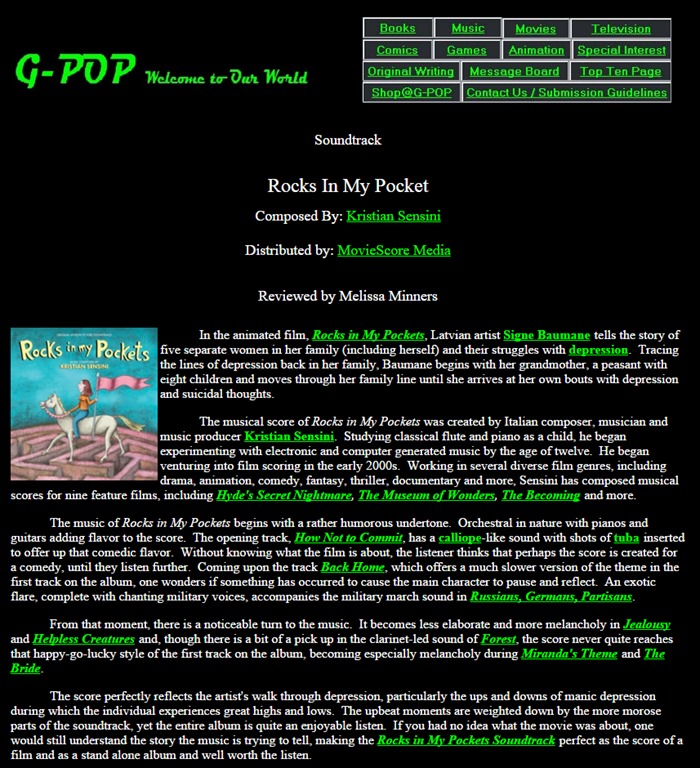
    The musical score of Rocks in My Pockets was created by Italian composer, musician and music producer Kristian Sensini.  Studying classical flute and piano as a child, he began experimenting with electronic and computer generated music by the age of twelve.  He began venturing into film scoring in the early 2000s.  Working in several diverse film genres, including drama, animation, comedy, fantasy, thriller, documentary and more, Sensini has composed musical scores for nine feature films, including Hyde’s Secret Nightmare, The Museum of Wonders, The Becoming and more.

    The music of Rocks in My Pockets begins with a rather humorous undertone.  Orchestral in nature with pianos and guitars adding flavor to the score.  The opening track, How Not to Commit, has a calliope-like sound with shots of tuba inserted to offer up that comedic flavor.  Without knowing what the film is about, the listener thinks that perhaps the score is created for a comedy, until they listen further.  Coming upon the track Back Home, which offers a much slower version of the theme in the first track on the album, one wonders if something has occurred to cause the main character to pause and reflect.  An exotic flare, complete with chanting military voices, accompanies the military march sound in Russians, Germans, Partisans

    From that moment, there is a noticeable turn to the music.  It becomes less elaborate and more melancholy in Jealousyand Helpless Creatures and, though there is a bit of a pick up in the clarinet-led sound of Forest, the score never quite reaches that happy-go-lucky style of the first track on the album, becoming especially melancholy during Miranda’s Theme and The Bride.

    The score perfectly reflects the artist’s walk through depression, particularly the ups and downs of manic depression during which the individual experiences great highs and lows.  The upbeat moments are weighted down by the more morose parts of the soundtrack, yet the entire album is quite an enjoyable listen.  If you had no idea what the movie was about, one would still understand the story the music is trying to tell, making the Rocks in My Pockets Soundtrack perfect as the score of a film and as a stand alone album and well worth the listen.

    Gpop RIMP